Uruk (modern Warka in southern Iraq, near Samawah) is often referred to as the world’s first true city, flourishing in the Uruk period (c. 4000–3100 BC)
By the end of this period, Uruk’s population may have reached tens of thousands and its urban expanse grew to 250–400 hectares. The city continued as a major center through the Early Dynastic era and beyond, though it saw periods of decline and revival under later dynasties
Uruk’s legacy includes the earliest known writing system, monumental architecture and profound influence on Mesopotamian civilization: in Mesopotamian myth, Uruk was the city of King Gilgamesh and historically it remained important into late antiquity (even receiving temple restorations under Seleucid rulers)
Religious architecture was central to Uruk’s urban identity – the city’s layout featured two great sacred precincts:
- the Eanna District dedicated to the goddess Inanna (later known as Ishtar)
- and the Anu District (at Kullaba) dedicated to the sky god Anu
These sanctuaries, roughly 500 meters apart, grew from simple cult sites into sprawling complexes that formed the spiritual and administrative heart of Uruk
Over centuries, each precinct was continually expanded and rebuilt, reflecting evolving architectural sophistication and religious practice: ziggurats – the characteristic stepped temple-towers of Mesopotamia – eventually crowned both precincts, symbolising the link between the city’s patrons and the divine realm
This brief post focuses on Uruk’s two principal ziggurats:
- the Eanna ziggurat
- and the Anu ziggurat,
introducing their design, construction phases, cultural significance and how they jointly illuminate the sacred urban layout of Uruk
And, at the end, comparative analysis highlights their differences and similarities in function, symbolism, chronology and structure

Me at the Eanna Ziggurat in Uruk, Iraq / Noémi Alzayadi
The Eanna Ziggurat and Precinct (Temple of Inanna)
The Eanna precinct underwent multiple construction phases, reflecting the transition from Ubaid-period temples to the grand edifices of the Uruk period and beyond:
Early levels (Uruk V and IV) reveal monumental mudbrick buildings which (though not ziggurats in the later sense) were precursors in scale and concept:
- Limestone Temple (Level V): a large tripartite temple built on stone foundations, using imported limestone slabs – this building may have been one of the earliest Inanna temples on site
- Early Mosaic Temple and Court (Level IVb): entering Eanna from the south, one would pass through Mosaic Court and Stone-Cone Mosaic Temple, both adorned with geometric clay-cone mosaics, a hallmark of Uruk’s temple design. Alongside were the Square Building and smaller shrines, forming a dense ritual complex
- Late Uruk rebuilds (Level IVa): the Eanna precinct was rebuilt on a monumental scale, featuring Temple D and Temple C with classic tripartite layouts, a Pillared Hall with stone-cone mosaics and a Great Courtyard for gatherings; the phase also included the Riemchen Building, a maze-like structure possibly used for ritual purposes. Thousands of proto-cuneiform tablets from this level highlight Eanna’s role as a center of economic and administrative management in Late Uruk
All of these pre-ziggurat constructions at Eanna were on ground level or modest platforms
However, in the Early Dynastic period and later, monumental stepped platforms were built:
During Uruk’s late decline, some temples fell out of use, but in the Ur III period the city experienced a renaissance:
King Ur-Nammu of Ur’s Third Dynasty – famed for building ziggurats – undertook major projects at Uruk. He (or his son Shulgi) constructed a massive ziggurat in the Eanna precinct dedicated to Inanna:
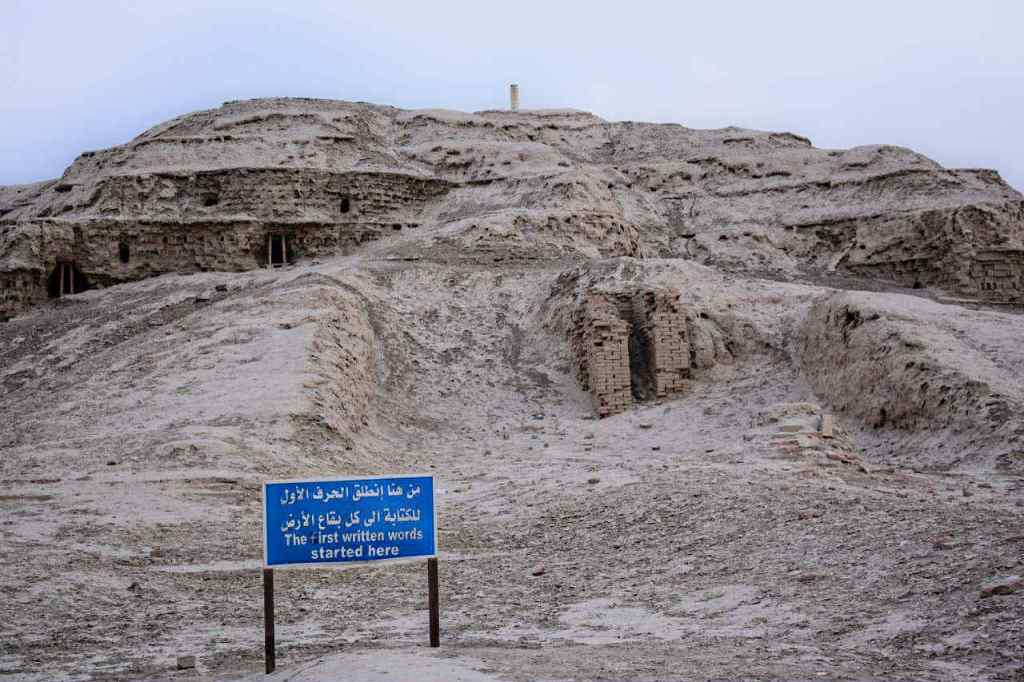
This Eanna ziggurat is the massive mudbrick tower still visible today, rising c. 30–40 meters
It likely consisted of a rectangular, multi-stage platform with a temple shrine at the summit, built of baked brick and asphalt over a mudbrick core – according to reconstructions, Ur-Nammu’s ziggurats had three levels with a grand staircase on the main facade
Eanna’s ziggurat almost certainly followed this template, much like Ur-Nammu’s famous Great Ziggurat at Ur
Did you know? A ziggurat built over a sacred legacy
Ur-Nammu’s ziggurat was an enlarged edition of a much older tradition:
in fact, excavations revealed that the Ur III builders built over earlier remains – beneath the Ur-Nammu terrace, archaeologists found earlier platforms and temples: the Red Temple with red-painted recesses and an even older limestone-based shrine that had been part of Eanna’s Uruk-period sacred architecture – one of these buried structures was a small mudbrick tower crowned by a White Temple (so-called from its white plastered walls)
This remarkable discovery demonstrated that Uruk’s Eanna precinct had its own proto-ziggurat and high temple circa 3000 BC, contemporaneous with the Anu precinct’s White Temple – which Ur-Nammu later built over
In summary, the architecture of the Eanna ziggurat evolved from ground-level decorated temples in the Uruk period to a towering staged pyramid by Ur III times
It physically elevated the goddess’s shrine high above the city – symbolizing Uruk’s aspiration to bring the realm of Inanna closer to heaven
Notably, the surrounding Eanna complex included courtyards and gates that forced worshipers into a processional journey upward: one entered a forecourt, ascended stairways and passed through terrace levels before reaching the top – this orchestrated movement created an experience of ascending from the profane city into progressively holier spaces: a theme that would recur in later ziggurat designs throughout Mesopotamia
As the seat of Inanna, the Eanna precinct was the spiritual heart of Uruk. Inanna (later known as Ishtar) was a complex deity – associated with love, fertility of the land but also warfare and the planet Venus
In Uruk’s ideology, she was the city’s divine patroness – the very name Eanna means House of Heaven
Religious ceremonies here would have centered on sacred marriage rituals, offerings of agricultural bounty and warfare tributes, aligning with Inanna’s domains
The famous Warka Vase (Uruk Vase), found in a deposit of the Eanna temple vividly illustrates a ritual procession in honor of the goddess: carved in alabaster, its registers show rows of plants and animals, nude priests bearing offerings and finally the presentation of gifts to a female deity (Inanna) who stands at her shrine’s entrance – this is one of the earliest known ritual narratives in art
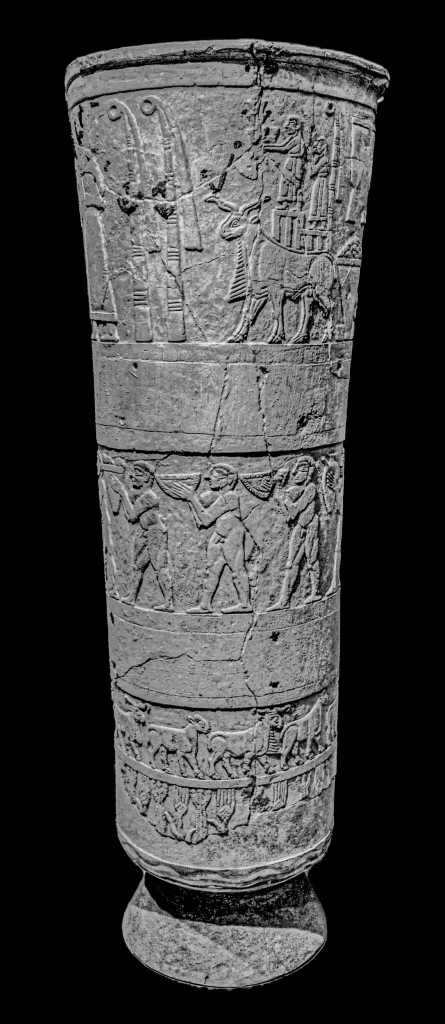
An alabaster vessel from Uruk’s Eanna precinct depicting one of the earliest narrative reliefs. A series of horizontal registers show:
1. Water and vegetation (fertility);
2. Livestock procession (temple economy);
3. Nude male offering bearers (ritual activity);
4. Presentation to Inanna, with a ruler and attendants (divine kingship)
Image: Public domain (Wikimedia Commons, CC0); modified by author (background removed, carving enhanced). Replica at the Pergamon Museum, Berlin
Inanna’s cult at Uruk was also politically significant: during the Uruk period, authority was likely vested in priestly officials of Eanna
Later Mesopotamian monarchs (from Sargon of Akkad to the Ur III kings) eagerly sought to legitimise their rule by honoring Ishtar of Uruk – the Eanna ziggurat and its temple likely hosted New Year festivals and other ceremonies where kings (or governors) participated to renew divine favor for the city
In Neo-Assyrian times, kings like Assurbanipal claimed to have restored Eanna, calling Uruk the dwelling of Anu and Ishtar – a dual cult that by then had merged Uruk’s two chief deities in ritual practice
Culturally, Eanna was a center of innovation. The earliest writing (proto-cuneiform pictographs) literally emerged from the Eanna precinct
The temple’s workshops produced fine goods: we find beautifully carved cylinder seals, jewelry and vessels (like the Warka Vase) dedicated to the goddess
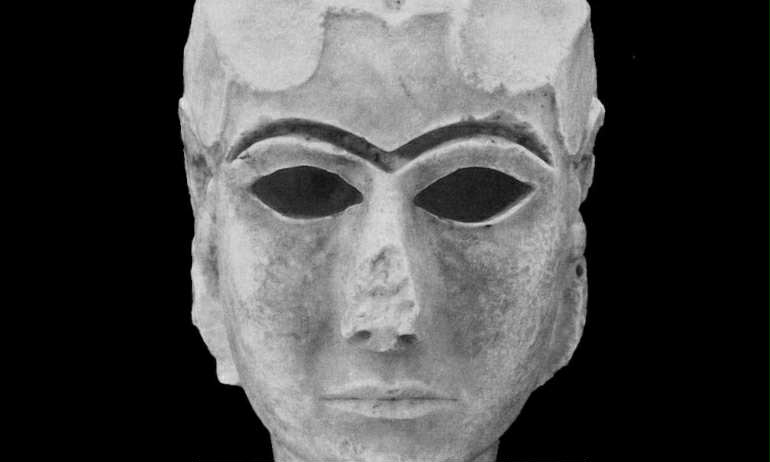
Art motifs from Uruk, such as the Lady of Uruk (a life-sized marble face of a woman – likely Inanna) uncovered in Eanna, represent some of the earliest naturalistic sculpture of the human face
The Eanna ziggurat, though eroded, still stands as a monumental mound that remains of Ur-Nammu’s brickwork. Modern visitors to Uruk can clearly see the outline of the ziggurat’s terraces and even traces of its brick facing – a striking marker at the site entrance proclaims Uruk as the place where “the first writing” began – a proud nod to Eanna’s global significance
The Anu Ziggurat and White Temple (Kullaba Precinct)
In Uruk’s northwest sector lay the Anu sanctuary (also called Kullaba), dominated by what is arguably Mesopotamia’s oldest monumental ziggurat
This structure, often referred to simply as the Anu Ziggurat, began as a large raised platform in the late 5th to early 4th millennium BC and was built up in stages over many centuries

- By the Late Uruk period: it supported a temple known as the White Temple – a nickname earned from the bright white gypsum plaster that coated its walls
- Uruk & Early Dynastic Periods: the Anu Ziggurat continued to be maintained and enlarged
- Post-Uruk Shift: importance shifted from Kullaba (Anu’s precinct) to Eanna (Inanna’s precinct), likely reflecting a shift in political-religious authority
- Ur III Period: unlike Eanna, the Anu precinct did not receive a large-scale ziggurat rebuild during this era, though it retained sacred status
- Hellenistic Resurgence: Uruk’s inhabitants built a new Bit Reš (Bit Resh) temple for Anu and Antu atop the old mound
In summary, the Anu Ziggurat and White Temple were the earliest monumental focal point of Uruk:
Starting as a great mound (perhaps natural at first, then augmented) where the sky god could be worshiped on high, it became a true ziggurat with a sophisticated temple – its shining white temple, high above the city, served as a stage for communing with the heavens
Later Mesopotamians looked back to this structure as a prototype:
The ziggurat of Uruk was later remembered among the “ancient towers” that inspired stories like the Tower of Babel myth. Although Babel is usually associated with Babylon’s ziggurat, scholars like Samuel Noah Kramer note that the idea of a primordial great ziggurat could have been inspired by ruins like Uruk’s, decaying by the first millennium but still impressive
Indeed, an ancient tablet from Uruk (copied in the Hellenistic era) describes its ziggurat as colossal – one late copy even gives it a fanciful height of 91 m (though this is likely an exaggeration or confusion with Babylon)
The Anu precinct had a different religious character from Eanna:
Anu was a sky god, one of the oldest in the Sumerian pantheon
Anu’s worship was likely more focused on cosmic order, calendrical rites and the king’s divine mandate
Unfortunately, few textual records survive specifically from Anu’s temple in Uruk, but later sources suggest that the White Temple would have housed a cult statue of Anu
The very elevation of the White Temple is significant: Mesopotamians believed that to commune with the divine, one went up – closer to the heavens: the ziggurat thus served as an artificial sacred mountain (in a landscape with no natural hills) on which the priest(s) could perform rituals on behalf of the community, bridging earth and sky
Anu’s role in royal ideology grew in later periods: Assyro-Babylonian kings took the title “Beloved of Anu”
The White Temple may have been the venue where Uruk’s priest-king (ensi) performed sacred leadership tasks – for example, the Ensi of Uruk could stand atop the ziggurat to make astronomical observations or pronounce judgments:
- one cylinder seal impression from Uruk period shows a priest or ruler with a “net skirt” garment (the so-called priest-king figure) next to animals and a temple facade, possibly referencing ritual activity at the Anu temple
- astronomy could also have been practiced on Anu’s ziggurat; later Babylonian tradition linked ziggurats with star-watching and Diodorus Siculus wrote that astronomers used a tower in “Uruk” for observing the stars – given Anu’s association with the heavens, it’s plausible the White Temple priests tracked heliacal risings of Venus or solstices from that vantage point, integrating early science with religion
In cultural terms, the Anu ziggurat set a precedent for monumental sacred architecture: it was one of the first structures to so clearly assert the presence of a tiered sacred platform, which became a defining feature of Mesopotamian cityscapes
Moreover, the Anu ziggurat’s continuous use and later revival show a strong cultural memory: when Uruk was refounded under Seleucid rule, priests deliberately revived the Anu cult – they built a new temple (Bit Resh) – in this Hellenistic-period revival, Anu and Antu were worshiped jointly, perhaps reflecting a cosmological duality (sky father and earth mother)
Thus, the symbolism of the Anu ziggurat can be summarized as representing cosmic order and continuity – it was at once an architectural innovation and a religious signal
In the Epic of Gilgamesh, Gilgamesh supposedly offers sacrifices to Anu and Inanna atop Uruk’s walls or ziggurat; while myth, this underscores how later generations imagined their heroes engaging with the gods at those high places
The White Temple’s design also inspired later ziggurats: for instance, the use of triple stairways on Ur III ziggurats might echo earlier forms and the whitewashed appearance might find resonance in the name “Babylon” (which Herodotus calls the “white temple” in one interpretation)
It was a self-contained sacred center that nonetheless defined the city’s identity as much as Eanna did
Both ziggurats together reflect the dual sacred identity of Uruk: one oriented toward the fecund earth and human society (Inanna’s), the other toward the celestial and eternal (Anu’s) – their coexistence in one city underscores how Uruk became a template for later Mesopotamian cities, combining multiple cult centers (eg. Babylon had Marduk’s ziggurat but also important temples to Ishtar etc.)
Uruk’s layout with two major ziggurats was somewhat exceptional, as most cities had one dominant ziggurat; this perhaps gave Uruk a reputation as a particularly holy city – in effect, it had double the divine presence:
Indeed, by the late 1st millennium, Uruk was termed “the dwelling of Anu and Ishtar” in cuneiform texts, formally recognising the twinned guardians of the city
Sources: The above synthesis is based on archaeological reports, museum collections and academic research, including:
- excavation summaries from the CDLI Uruk Wiki
- Leon Legrain’s 1944 Uruk Period analysis
- comparative data on ziggurats from the World History Encyclopedia
- publications of artifacts such as the Warka Vase and Mask of Warka
- the Pergamon Museum’s Uruk exhibition notes
- Rost Architects’ architectural history of Uruk

 Visus Nomadum